Table of Contents
What Responsible AI in Hiring Looks Like
If you run a business with fewer than fifty people, hiring probably isn’t your job. It’s the thing you do between running payroll, walking a customer through pricing, and putting out whatever fire showed up in your inbox this morning. And yet recruiting teams spend 35% of their time on back-office work that doesn’t move a hire forward: interview scheduling, ATS and HRIS integrations, implementation, and the rest of the logistics that keep things running without actually landing you a hire. That’s not client calls, strategy, or the actual work of running a business. That’s writing the job post. Reposting it when nobody applies. Scrolling resumes. Chasing candidates who ghost you after two texts. Rescheduling the interview for the third time.
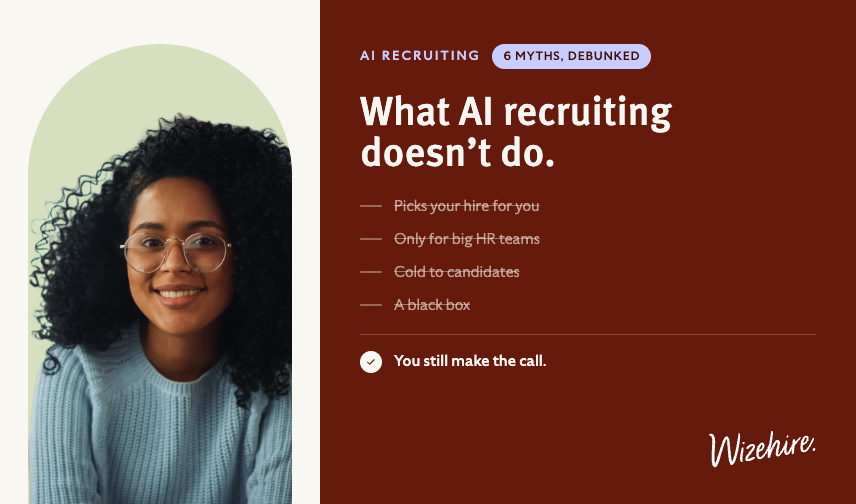
That’s the real math of hiring without help, and it’s exactly the gap AI recruiting is supposed to close. But the term has picked up some baggage along the way. Some leaders hear “AI recruiting” and picture a machine screening their future employees with the warmth of a parking meter. Others assume it’s a toy for companies big enough to have a large HR department. Neither one is true, so let’s go through what AI recruiting actually does, one myth at a time.
Does AI recruiting decide who gets hired?
No, or at least it shouldn’t. What AI recruiting is supposed to do is cut down the pile you’re wading through so the good candidates rise to the top instead of getting buried under hundreds of applications from people who didn’t read the job title. The decision stays yours. Think of it less like a hiring manager and more like the world’s fastest, least tired assistant, one who never gets bored on résumé fifty and starts skimming.
If you’re evaluating a tool and it’s not clear whether a human or the software makes the final call, ask directly. A responsibly built AI recruiting tool will tell you plainly that it surfaces and ranks, and that a person still decides.
Is AI recruiting only for businesses with HR departments?
This is backwards. The bigger your team, the more slack you have to absorb a bad hiring process. A 500-person company can afford a few weeks of chaos on an open role. A 12-person shop can’t. If you’re the owner, the office manager, and the person who has to cover the shift when a role sits open too long, that one-third of your week spent on hiring admin is worth more to you than it is to almost anyone at a big company.
Many of the AI recruiting tools were built with large, Fortune 500 companies in mind. Make sure to search for AI that was built with lean teams in mind, not big HR departments with headcount to spare. It’s worth being skeptical of any tool that feels like a scaled-down version of enterprise software rather than something built for how a small team actually operates.
Does AI recruiting feel cold and impersonal to candidates?
The opposite tends to happen when it’s done well. When the busywork gets handled automatically, the humans on your team actually have time to have real conversations instead of firing off the same three form emails all week. The scheduling and sorting gets handled so a person can do the part that actually requires being a person: the phone call, the gut check, the offer conversation.
The tools worth using pair software with real support, not software instead of it. If a platform’s answer to “will this replace the people I talk to” is anything other than a clear no, that’s worth a second look.
Is AI recruiting a black box you just have to trust?
A fair worry, and one worth asking any vendor directly. A strong match shouldn’t be a mysterious score, it should come with a clear, visible reason: this candidate has the licenses you need, lives fifteen minutes from your shop, and has three years doing the job you’re hiring for. If a tool can’t tell you why it’s recommending someone, that’s a real red flag.
It’s also fair to ask who’s checking the tool’s work. Responsible AI recruiting platforms get audited by an independent third party for bias, not just self-reported, and are built to align with the regulations that actually govern this space, including NYC’s Local Law 144 and the Colorado AI Act.

“Every recommendation comes with a reason you can see and check. Our AI surfaces what matters. The hiring decision stays with you, always.”
– Sid Upadhyay, Wizehire Co-founder & CEO
Does AI recruiting use your data to profile candidates from around the web?
This is a newer worry, and a fair one given how much AI headline anxiety is about data scraping. It’s a good question to ask directly: does this tool train on data pulled from other sites, other companies, or the open internet, or does it only work from what you and your candidates actually put into the platform? The better answer is the second one. No hidden sources, no scraped profiles, nothing happening behind a curtain you can’t see.
Does AI recruiting slow you down while you learn it?
The whole point cuts the other direction. According to a December 2025 study of Wizehire customers, candidates screened manually take an average of 44 days to hire, compared to about 11 days for candidates surfaced through Talent Match, Wizehire’s AI-powered matching engine, a 4x improvement for similar roles. That’s not because the software is flashy; it’s because it’s doing the repetitive parts of the job while you’re doing literally anything else. None of that requires a learning curve.

None of this means every AI recruiting tool gets it right, plenty don’t, which is exactly why the questions above are worth asking before you trust one with your hiring. We built Wizehire, an AI-native recruiting platform, around the idea that the software should handle the busywork so you can focus on people, and it’s part of why our customers find and hire qualified talent roughly 4x faster. But whichever tool you land on, ask it the same questions. A good one will have real answers.
Author

Share



 See How It Works