
Table of Contents
What Is a Job Board?
A job board, sometimes called a job site, is an online listing service where employers post open positions and job seekers search and apply for them. Think of it as a digital bulletin board. You create an account, write a job post, and candidates scroll through looking for something that fits.
Common examples include LinkedIn, Indeed, and ZipRecruiter. Some are broad, built for every industry and role. Others are niche, focused on specific trades, industries, or experience levels.
Job boards are good at one thing: distribution. When you post on a job board, your listing goes in front of job seekers who are actively looking. Forty-five percent of small businesses rely on job boards as a primary sourcing channel, and for straightforward roles in high-traffic markets, they can still generate applicant volume quickly.
What job boards don’t do: screen or evaluate candidates for you, help you write a stronger job description, centralize candidate communications, move candidates through a hiring workflow, give you insight into candidate behavior or job readiness, or support onboarding after a hire is made.
In short: a job board gets you applications. What you do with them is entirely up to you.
Post to 100+ job boards with one click
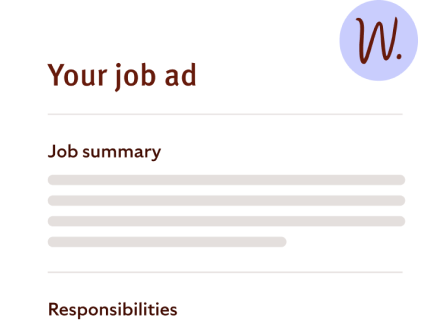
What Is a Hiring Platform?
A hiring platform is an end-to-end toolset that manages the entire hiring journey, from the moment you write a job post to the day your new employee starts. At its core is a robust applicant tracking system (ATS), but modern platforms go well beyond tracking. They automate the time-consuming parts of hiring, help you evaluate candidates more rigorously, and give you the data to make better decisions faster.
Here’s how the feature set breaks down.
Core Features
- Applicant tracking system (ATS): A centralized pipeline that manages every candidate from application to offer in one place, no spreadsheets or inbox-hunting required
- Multi-board job distribution: Post to 100+ job boards simultaneously with a single click, including LinkedIn, Indeed, and ZipRecruiter
- Job description templates: Pre-built, optimized templates that help you write stronger posts faster
- Career page: A branded destination for candidates to learn about your company and apply directly
- Universal inbox: All candidate communications, across every channel, in one place
Automation and AI
- AI-recommended next actions: Surfaces prioritized next steps directly in your dashboard so you always know what to do and which candidates to move forward
- Screening questions and must-have qualifiers: Filter out unqualified applicants before a human ever reviews them
- DISC+ behavioral assessment: Evaluates how candidates think, communicate, and perform under pressure, not just what their resume saysA
- Automated phone screening: Conduct initial screens at scale without adding hours to your team’s calendar
- SMS texting: Two-way candidate communication that moves faster than email and dramatically reduces ghosting
- Self-scheduling: Calendar integrations that lets candidates book their own interview slots, eliminating scheduling back-and-forth
Strategic Tools
- Interview guides and structured scoring: Consistent evaluation criteria across every candidate so hiring decisions are based on evidence, not gut feel
- Candidate Forecast and Job Health: Real-time data on how your posting is performing so you can adjust before visibility drops
- Hiring analytics: Track time-to-hire, cost-per-hire, and source quality across your pipeline
- Payroll and HRIS integrations: Direct connections to QuickBooks, Gusto, ADP, Paychex, Paycor, and Paylocity for a smooth handoff from candidate to new employee
- Onboarding tools: Hiring checklists, e-sign offer letters, and WOTC tax credit detection built into the post-hire workflow
According to Wizehire’s Small Business Survey, only 3% of small businesses currently use an online HR tool or platform to source, evaluate, and hire candidates. That gap represents a significant competitive advantage for the businesses that do.
What’s the Real Difference Between a Job Board and a Hiring Platform?
The simplest way to think about it: a job board is a sourcing channel. A hiring platform is a hiring system.
Job boards are designed to generate applicant volume. Once someone applies, you’re on your own. Managing candidates, communicating with them, evaluating them, scheduling interviews, and moving toward an offer all happens outside the job board, in whatever tools you’re already using.
Hiring platforms are designed to manage the entire process. You still post to job boards (typically many of them at once), but the platform also gives you the infrastructure to move candidates efficiently from application to offer without things falling through the cracks.
The distinction matters most when you’re dealing with high application volume, hiring across multiple roles, or when the cost of a bad hire is high enough that you need structured evaluation, not just gut instinct and resume skimming.
How Job Boards Have Changed (What Every Employer Should Know in 2026)
This is the part of the conversation that’s often missing from the job boards vs. platforms comparison, and it’s important.
Job boards have shifted significantly over the past year or two, and not in employers’ favor.
Organic visibility has become less predictable. Most major platforms have shortened the window during which free job posts receive meaningful exposure. Where a post might have generated steady applicant flow for weeks in the past, that window has compressed. Paid distribution has become the de facto standard for employers who want consistent reach.
Algorithms now evaluate your posting in real time. On many platforms, your post’s performance in the first 24 to 72 hours determines how much further it gets distributed. If candidates are clicking, applying, and you’re responding quickly, visibility holds. If those signals are weak, distribution drops, whether you paid for it or not. Visibility isn’t static. It decays based on performance.
Wizehire Scout, our AI-powered hiring assistant, surfaces next-best actions directly in your dashboard so you know precisely what to do and when during those critical first 24 to 72 hours, before visibility has a chance to drop.
AI has flooded the applicant pipeline. 87% of companies now use AI in some part of their recruitment process, and candidates are using it too. AI tools make it easy to generate polished resumes and apply to dozens or hundreds of roles in a single session, auto-tailoring applications for each one. The result: application volume is up, but signal quality has dropped sharply. Some employers are receiving 1,200+ applications within 48 hours for a single role, and hiring no one from that pool because resumes looked strong on paper but candidates couldn’t back them up. 90% of HR managers say their workload has increased because of AI-generated applications.
This is the central tension job boards weren’t designed to solve. They were built to deliver applications. Evaluating whether those applications are genuine, qualified, and worth your time is a different problem entirely.
Why Are You Getting So Many Unqualified Applicants?
If your job posts are generating high volume but low quality, you’re not alone and you’re not doing anything wrong. It’s a structural problem with how the market has shifted.
Three things are happening at once.
First, AI-assisted applications have raised volume without raising quality. Candidates can apply to 50 or 100 roles in a session with tailored resumes that look strong on paper. When you’re one of 100 applications someone fired off in a single sitting, the signal in that resume is close to zero.
Second, easy-apply features reduce friction in ways that benefit candidates but not employers. When someone can apply in two clicks without answering questions, you’re getting every possible applicant, not just the interested and qualified ones.
Third, most job boards don’t give you tools to filter before applications reach your inbox. Screening questions, behavioral assessments, and qualifier questions that automatically route out candidates who don’t meet basic requirements aren’t job board features. They’re hiring platform features.
21% of employers say they can no longer reliably distinguish AI-generated resumes from authentic ones. The fix is adding structure at the top of your funnel, before a human ever has to read a single application.The fix is adding structure at the top of your funnel: pre-screening questions that require a real answer, must-have qualifiers that route out candidates who don’t meet baseline requirements, and behavioral assessments that give you insight into how someone actually works before you invest an hour on a phone screen. That structure lives on a hiring platform, not on a job board. And once qualified candidates are in your pipeline, Scout keeps you moving by surfacing exactly what to do next so strong candidates don’t go cold while you’re figuring out the next step.
When Should You Use a Job Board vs. a Hiring Platform?
A job board may be sufficient if:
- You’re hiring for a single, one-off role in a market with strong candidate supply
- You have internal bandwidth to manually sort, screen, and communicate with every applicant
- Your hiring process is informal enough that you don’t need a structured evaluation framework
A hiring platform is likely what you need if:
- You’re hiring more than one or two roles at a time
- You’re seeing high application volume but struggling to find qualified candidates within it
- Slow hiring is costing you productivity or putting pressure on your existing team
- You’ve had bad hires and want a more structured process to reduce that risk
- You want your hiring process to be repeatable, especially as you grow
- You want to maintain a talent pipeline so you’re not starting from scratch each time a role opens
For most growing businesses, the real question isn’t “job board or hiring platform.” It’s whether you’re using a hiring platform that distributes to the right job boards, so you get the reach of a job board and the infrastructure to actually hire well.
Signs It’s Time to Move Beyond Job Boards
You’re posting jobs and not getting enough qualified applicants. Not enough applicants at all, or high volume that doesn’t convert to real candidates, are both signs that distribution alone isn’t enough.
You’re spending too much time manually sorting applications. If a hiring manager is spending hours sorting through applications to surface a handful of real candidates, the process has a structural problem.
You’re not sure how to evaluate candidates fairly and consistently. If every hiring decision feels like a judgment call with limited information, structured assessments and interview guides address that directly.
You’ve been ghosted by candidates who seemed strong. 76% of employers report being ghosted by candidates, often because those candidates applied to many roles simultaneously and moved on. Faster communication tools close that gap.
You’re hiring for multiple roles or building out a team. Doing that manually across individual job boards is unsustainable.You want to reduce employee turnover. A structured process that evaluates culture fit and readiness more rigorously leads to better hires who stay longer, and lowers your cost per hire over time.
How Wizehire Helps
Wizehire is built to handle what job boards can’t: not just getting your job in front of candidates, but helping you evaluate, communicate with, and hire the right ones efficiently.
Every job posted through Wizehire is distributed to 100+ job boards simultaneously, so you’re not choosing between reach and infrastructure. You get both.
On the screening side, Wizehire includes a bank of pre-built screening questions, must-have qualifier questions, DISC+ behavioral assessment, and automated phone screening, all designed to surface qualified candidates from a noisy applicant pool. Interview guides and structured scoring keep your evaluation consistent across every candidate.
On the speed and communication side, the Universal Inbox centralizes all candidate messaging, SMS texting keeps conversations moving, and calendar integration makes scheduling frictionless. Candidate Forecast and Job Health tools give you real-time visibility into how your posting is performing so you can make adjustments before visibility drops.
After a candidate accepts, hiring checklists, e-sign offer letters, and payroll integrations with QuickBooks, Gusto, ADP, Paychex, Paycor, and Paylocity support a smooth transition from candidate to new hire.
Every plan includes coaching sessions with Wizehire’s team of hiring coaches, giving you the structure and support to hire consistently, even when market conditions shift.
Frequently Asked Questions
The biggest downside isn’t cost or competition. It’s the lack of infrastructure to evaluate what comes in. Job boards generate applications but give you no tools to screen them efficiently, communicate with candidates in a structured way, or assess who’s actually qualified. In an environment where AI-generated applications are flooding inboxes, manual sorting through a job board is increasingly time-consuming and unreliable.
LinkedIn is primarily a professional networking platform, but its job posting functionality operates as a job board. Candidates search and apply for jobs through LinkedIn the same way they do on Indeed or ZipRecruiter. LinkedIn does offer some supplemental sourcing tools, but its standard job posting features are functionally a job board, not a hiring platform. Wizehire integrates with LinkedIn to ensure your job ads reach the right audience there automatically.
Indeed is a job board. It’s one of the largest in the world by traffic, and it offers some supplemental tools, but it is not a full hiring platform. It doesn’t provide end-to-end candidate management, behavioral assessment, or onboarding integrations the way dedicated hiring platforms do.
The most meaningful differences are applicant tracking, structured screening, behavioral assessment, candidate communication tools (especially SMS), and interview guides. A hiring platform also distributes your job to multiple boards simultaneously, so you don’t lose reach by choosing one over the other. You get both.
Yes. Wizehire is a full-service hiring platform designed to help businesses find and hire the right people efficiently. It includes job posting distribution across 100+ boards, candidate screening tools, DISC+ behavioral assessment, interview scheduling, onboarding integrations, and dedicated hiring coaching. Unlike traditional job boards, Wizehire supports the entire process from posting to hire.
Organize and filter your candidates with ease

Author

Share



 See How It Works